The question
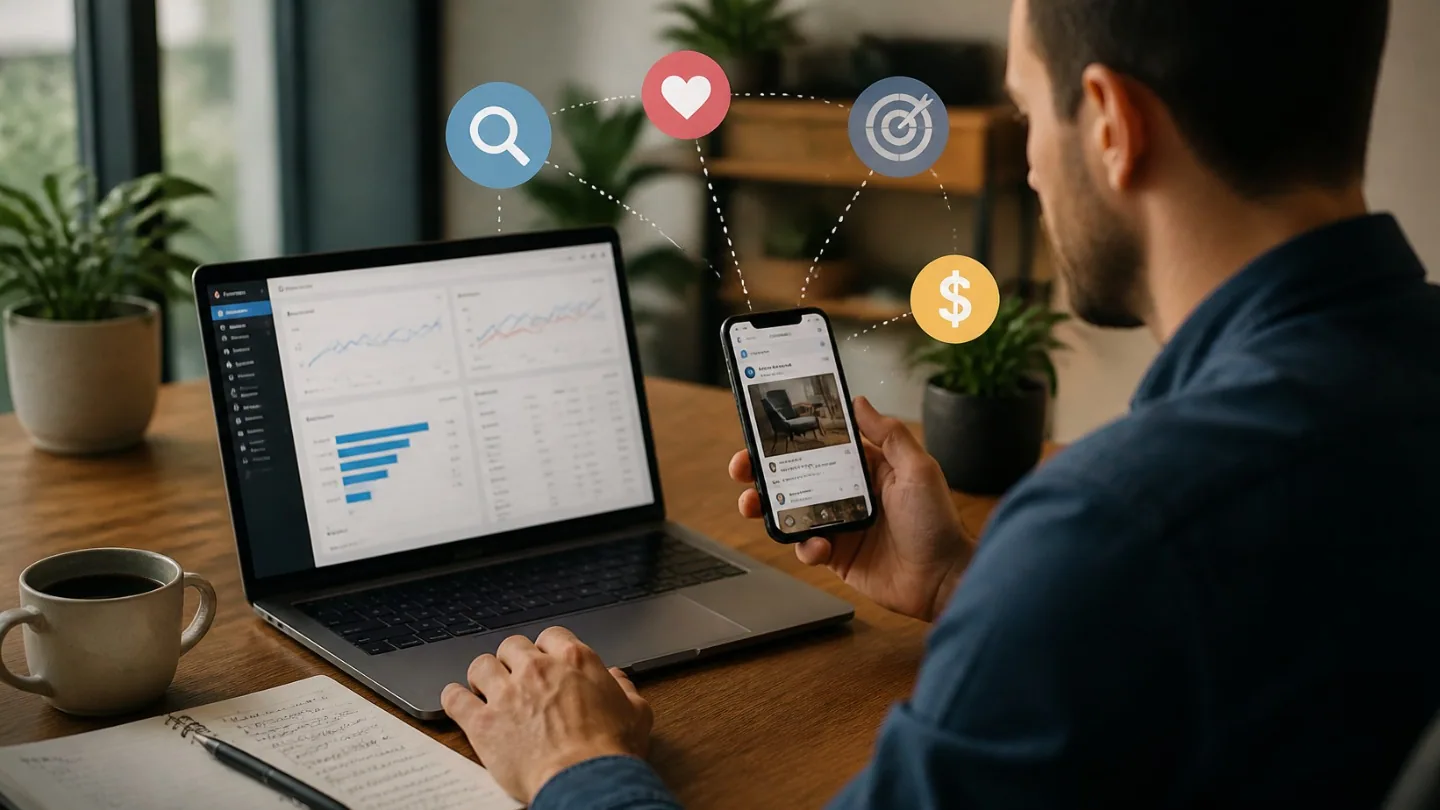
We want to start online advertising, but our budget does not allow us to be everywhere. Should we start with Google Ads or with Facebook and Instagram ads?
When the promotion budget is limited, launching on several channels at once splits the money into pieces too small to learn what works. That is why the question “Google or Facebook?” is a good one: the answer depends on how your customers usually find a service or product like yours.
This guide explains the fundamental difference between the two channels, the situations in which one has a natural advantage, what to prepare before the first campaign and how to compare results properly. It contains no recommended rates or budgets: costs depend on the industry, the area and the competition, and they change over time.
If you want us to handle this for you, see our service Google Ads or our service Facebook and Instagram Ads (Meta Ads).
The fundamental difference: demand that already exists or demand that you create
Google Search ads appear when someone has already typed what they want: “emergency electrician”, “christening gift”, “accountant for a sole trader (PFA)”. The person has a need they have put into words, and the ad answers it at that very moment. Your job is to appear for the right searches, with an ad and a page that answer them exactly.
On Facebook and Instagram, people are not searching for anything in particular; they are scrolling. The ad has to catch their attention and show them a need or an offer they may not have been thinking about. You choose the audience by area, age, interests or by the fact that they have already visited your website, and the image or video matters far more than it does in search.
In short: Google captures existing demand, while Meta (the company that runs Facebook and Instagram) mainly helps to create demand and remind people of it. Both platforms also have other formats, such as video ads or ads shown on other websites, but for a first decision the difference above is the one that matters.
When it makes sense to start with Google Ads
Search has a natural advantage when the customer knows what they need and is actively looking for a supplier. Signs that this is your case:
- People have an urgent or specific problem and look for a solution on the spot: repairs, emergency call-outs, home services.
- You offer a service that the customer compares before deciding: a lawyer, an accountant, a clinic, transport.
- You sell products that people search for by name, code or precise specifications.
- You work in a clearly defined geographical area and want to appear only there, and only when someone can take the call.
- The product or service is hard to show in an image but easy to describe in the words the customer uses.
When it makes sense to start with Facebook and Instagram Ads
Social networks have a natural advantage when people do not yet know about you or your product, but may want it once they see it. Signs that this is your case:
- The product is understood and desired from an image or a short video: fashion, decorations, food, handmade products.
- You have something new that nobody is searching for by name yet.
- You work locally, with services that people also choose on impulse or on recommendation: salons, restaurants, courses, events.
- You already have website visitors who leave without buying and you want to bring them back.
- Customers prefer to send you a message rather than fill in a form or phone.
What to prepare before the first campaign, whichever channel you choose
A significant part of the money lost on advertising has nothing to do with the choice of channel, but with what happens after the click. Before you start, check:
- A landing page that continues the message of the ad exactly, not the website’s home page, where visitors have to search for themselves.
- A clear action that you expect from the visitor: a call, a form, a message, an order.
- Measurement of that action set up and tested before launch, not after the first days of spending.
- Someone who answers the phone and messages during the hours when the ads are running.
- A cookie banner and tracking consent configured in line with the applicable rules, checked with whoever handles the legal side.
- Ad accounts created in the company’s name, with administrator access for you, even if someone else manages them.
How to measure and compare the two channels
Each platform reports its own figures: impressions, clicks, views. These do not tell you whether the ad brought in customers. Compare the channels by the same business outcome: how many real enquiries, calls or orders each one brought in, and how much each of them cost on average.
Bear in mind that people do not always buy on first contact. Someone may see an ad on Instagram and then search for you on Google a few days later. That is why each platform tends to claim the credit for itself, and their reports, added together, can count the same order twice. A common source, such as the website’s analytics tool or the record of enquiries in your CRM, gives a more accurate picture.
Also ask new customers where they heard about you. The answers are not precise, but they usefully complement the data in the reports, especially for phone calls and in-person visits.
How to test with a limited budget
With a small budget, the safest approach is to start with a single channel, one or two simple campaigns and a single objective. Let the campaign run long enough to gather data before drawing conclusions: daily changes prevent it from stabilising and make the results hard to interpret.
Set in advance the criterion by which you will decide: for example, how much you are willing to pay for a quote request or for an order, based on your margin and on what a customer is worth to the business. Without this criterion, any result can look both good and poor.
Add the second channel once the first one is working and you have learned something from it: which messages attract enquiries, which areas or products bring in customers, which questions people ask. This information can also be used directly in the campaigns on the other channel.
Common mistakes at the start
A few situations recur among businesses that start advertising without help or with the default settings:
- In Google Ads, search terms that are too broad and have no excluded keywords, bringing clicks from people who are looking for something else.
- On Facebook and Instagram, boosting posts straight from the page, without a chosen audience and without measuring the results.
- Automatic settings recommended by the platform accepted without understanding what they expand: areas, networks or display types.
- Ads that run at night or at weekends, when nobody answers the phone.
- Conclusions drawn after a few days or after very few clicks.
- No clear record of the enquiries received, so nobody can say what the ad brought in.
Questions for the decision
The answers to the questions below usually indicate the channel that is worth starting with:
- Do your customers actively search for what you offer, or do they only learn about you when they see your product?
- Which is easier to understand: a description in a few words, or an image or a video?
- What action do you want from the customer: a call, a form, a message or an online order?
- Do you have a suitable landing page and measurement of the action set up?
- Who answers enquiries, and during what hours?
- What cost per new customer can you afford, based on your margin?
- Who owns the ad accounts and who has access to the reports?